On Gregory Leadbetter’s ‘Dérive’ and ways to see the city

When I read Gregory Leadbetter’s latest collection Maskwork (Nine Arches Press, 2020) ahead of our podcast recording with him, I did it with a stack of sticky notes at my side, ready to tab any poems that felt relevant to Overhear and the ideas we’re particularly interested in – place, technology, cities and Birmingham in particular, among other things. By the time I closed the book, there was a fringe of neon paper fanned out along the top of the pages, plus a 400-word Google Doc of my thoughts on what I’d been reading. Needless to say, we did not have anywhere near enough time to talk about all of it with Greg – as wonderful as the forty minutes we did have with him were – so I’ve decided to write up some of the other thoughts I had into a blogpost: part poetry review, part only-semi-lucid ramblings of a person who has been in lockdown for far too long.
I’ll begin with a poem we did get to talk about, which was ‘Beorma’, a kind of tribute to Birmingham through an exploration of its origins, as a place and as a word. Greg talked to us about the idea that we are continually reinventing ourselves and our world, and how etymology, the study of words and their histories, can reveal that often hidden process to us. We touched several times on the notion that the things we think of as fixed in our day to day lives are almost always anything but. Ideas of place, reality and identity (individual and collective) are instead subject to continual change, shifting and evolving – and this poem is a wonderful encapsulation of that in relation to the city of Birmingham.
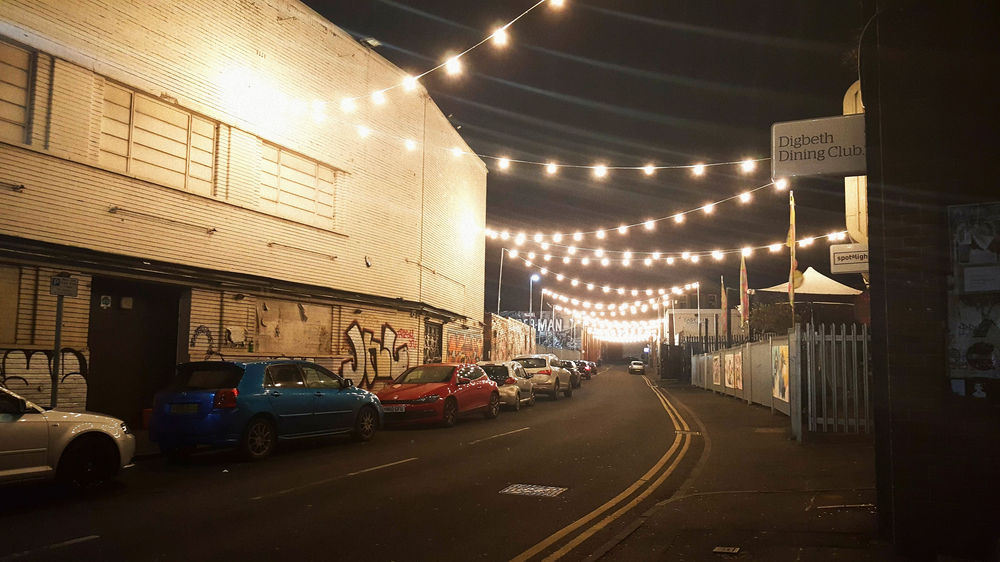
A poem that seems to (if you can forgive me the pun) walk with this idea is ‘Dérive’, which we didn’t get around to talking about during the podcast. As explained in Greg’s notes at the back of Maskwork, the title ‘comes from the French for “drifting”, relating to the psychogeographical practice […] of traversing urban or semi-urban terrain in a deliberately experimental attitude,’ which is exactly what the subject of the poem does. That sounds (again, forgive me) right up our street. Finding new ways to explore spaces is what we’re all about, and I loved reading this poem and getting to see how those ideas were expressed and embodied through the language and images of the work.
The first sentence, ‘turn around three times and walk’ sets the tone for the whole experience; this is a process of disorientation rather than orientation, you have to be dizzy and defamiliarised before you take your first step. There’s no clear destination set out and no map to take you there – in fact, the first image of the poem is an atlas made soggy and useless by nature’s own ‘November rain’ and anyway, the poem points out that it was ‘out of date before it got soaked’. Again we come back to the question of fixedness: we think of maps as a way to capture and pin down (truly, I’m sorry) physical spaces but even those are subject to change, as anyone who has ever tried to navigate using an old A to Z will confirm. More than that, they fail to capture much of what makes up the human experience of physical spaces, some of which this poem goes on to explore.
Thinking back to ‘Beorma’, we talked about how the name of a place can tell part of its story. However, in keeping with the theme of defamiliarization, this poem seems more interested in un-naming the place. We only ever get the name of the area backwards and italicised: ‘Doowylloh/ which spools a film in misheard Welsh…’. This is a reversed naming process, in which the speaker imagines what the place with this inverted name might be, unmaking the familiar history and opening up new possibilities for reinterpretation and through it, transformation. When we go from this straight into the first use of the first person and mention of the speaker’s history (‘…from the faint cry of my missing ancestry’), it feels as though this is a consequence of the un-naming process. Deconstructing the name, and therefore identity, of the place has allowed for the personal to enter the narrative – there’s now space for the individual to become part of the landscape and its story.

From here the personal experience is centred as we get sensory details of the journey, from the sound of birdsong to the smell of hot pork rolls but this is not the only lens through which we see the environment. The poem really seems to embody the feeling of meandering without a set destination; its stream-of-consciousness voice conveys the sense of the subject going wherever the mood takes them. During our podcast recording, Greg talked about leaving room for the more intangible aspects of space, and we get those here too. The added texture of memories – other walks through the same space and their collective significance – and possible futures build up a fuller experience of the space by breaking down precisely those parameters by which we usually define those experiences. I was delighted by how time as well as space seemed to fall apart as the poem continued, particularly the lines ‘a neighbour I have never yet met looks a little lost/as if he had turned three times and fifty years/had passed’.
During Greg’s launch event, he talked about the title of the collection and his interest in masks in general. He brought up philosopher John Grey, and his separation of ‘unadorned reality’ from ‘artful illusion’ to which Greg added the alternative third option of ‘artful reality’. He argued that the addition of memory, of myth, and the projection of the personal onto so-called unadorned reality wasn’t an act of obscuration but an act of revelation, giving us access to the less tangible dimensions of our experience and understanding of the world which otherwise go unnoticed or unexamined.
For me, this hugely echoes my musings on what I love so much about Overhear as a project. What we do when we pin poetry to places could also be seen as an obfuscating addition: are we romanticising your local pub and disguising its true nature by asking a poet to write about it? Well, in my humble and not entirely unbiased opinion… no. In fact, what we’re asking you to do – helping you to do – is what the subject of Greg’s poem does in ‘Dérive’: let go of the usual boundaries and restrictions that shape how you experience and live in the world and open yourself up to the possibility of something more.
This blogpost could have been triple the length; I could go on about these ideas forever. If you’re interested in reading more on the subjects we discussed I’d recommend some of the reading below:
- Guy Debord’s Society of the Spectacle which Greg references in the notes for ‘Dérive’ or this handy illustrated summary of some of its ideas.
- Frederick Jameson’s essay ‘Postmodernism or the Cultural Logic of Late Capitalism’, specifically the section that talks about The Bonaventura Hotel as a microcosm of the postmodern city
Of course, if you haven’t listened to our podcast with Greg, I cannot recommend it enough, he has far more lucid thoughts on cities, space and writing which you can listen to here.
His collection Maskwork is available to order from Nine Arches Press right now, and if this 1000 word blogpost on just one of the poems contained can’t convince you you’ll get a lot out of it, I’d also recommend watching the launch event with Nine Arches, which was filmed as posted on their YouTube channel here.
Symbiosis: On Mushrooms and Poetry
Hello, Tom here.
I’ve been reading up on fungus!
And as I’m sure you’re already aware its got everything to do with Poetry and Place…
In the lead up to, and facilitating of, our Plant-A-Poem workshops with Highbury Community Orchard, the Overhear team have had their collective head in the world of Growing, Grafting and Foraging for a few weeks. It was just after this that I started reading “Entangled Life: How Fungi Make Our Worlds, Change Our Minds & Shape Our Futures” by Merlin Sheldrake. Now, I’m already familiar with the Sheldrake family through Merlin’s brother Cosm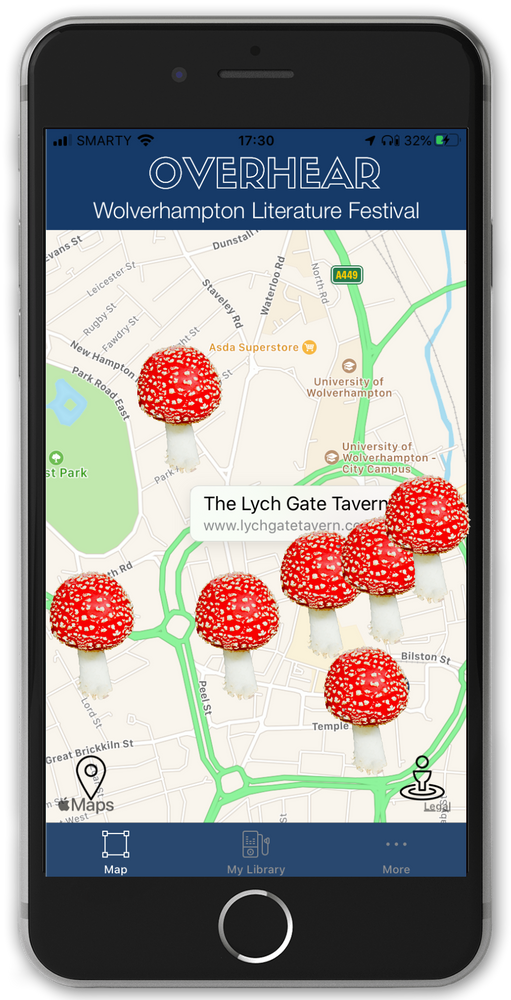 o (their parents didn’t hold back with the wack names!) an established songwriter and multi-instrumentalist who I know best because of his Tardigrade song:
I love a song about a micro-organism!
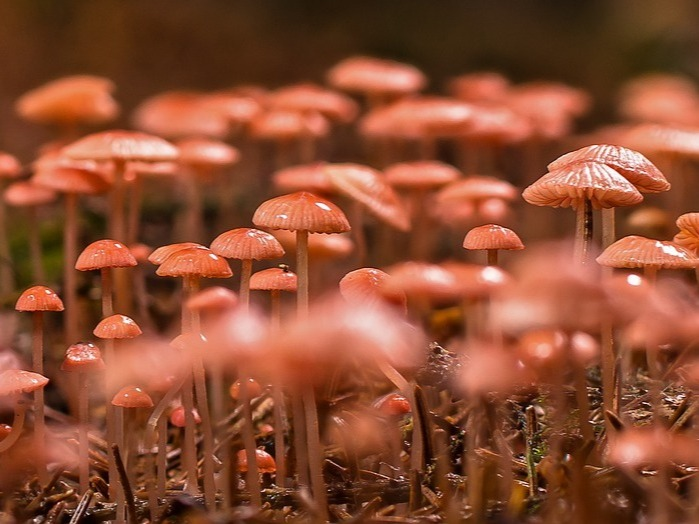
Merlin, with a similar interest in the microscopic, has written this book which is rich with a poetry about the interconnected, networked world of fungi. Viewing the world through this mycology and seeing Overhear through its eyes has compelled me to pen this blog with a few of my own meandering ideas. How do the poems we commission interact with space and location and what advice we can take from the mushrooms’ way of living when attending to place? Some fungi are known to push up through tarmac roads and bloom in the most unusual of spaces, this made me think of the relationship between poetry and space we are trying to nurture… the micellean network of poets with their words and metaphors intertwining with the buildings, histories and narratives of space in a way that could change their very makeup, the way we look at them, approach them and understand them.
I’m really enthused by the idea that everything is interwoven and connected in some way (hence why I’m blogging about poetry and fungus) and that there is a symbiosis between all living things. Place and location blur into the background without a strong narrative; that can be the beauty of some parts of the countryside they’re ripe for exploring, and uncovering/telling stories about but also the tragedy of abandoned forgotten places or places that have been reduced to wasteland.
Other places are littered with narratives that intrude and barge their way in front of us on billboards or on ring-roads and skyscrapers, or amaze us because of their ingenuity and design. Take a listen to Gregory Leadbetter talking about exactly this, on our Podcast here.
Could it also be argued that poetry needs a setting or a context in which to take root and to be made sense of? We think poetry is integral to forming the narrative in a location, poetry can shape the way people see, interact with and view a place’s past, present and future. Its networks of words and ideas can slowly take over and reclaim space, break up seemingly impenetrable surfaces through its steady growth in the right conditions.
We’re really excited to see how our poems take root in the places they’ve been written for and how users discover them and attend to the locations through the perspective of poetry.

We don’t have Users, we have Listeners
Overhear Co-director and Creative Development Lead Adrian B. Earle sits down to reflect on his history of engaging with the internet, why the language we use to talk about technological communities matters & how, when you choose to make it matter, the world changes.

This is my first Blog for Overhear! So I think it’s worth you all knowing I am just about older than the internet. Literally, just. But I don’t think I have ever been a ‘User’.
I was born at the tail end of ’89 and the first browser, ‘WorldWideWeb’ (later renamed Nexus… much cooler) was the only way to access the nascent internet.
I got to grow up with the promise of all the world’s information at my fingertips, the utopia of information set free, if only you could spend the time to grasp the technology involved in its emancipation.
My childhood internet was a whirring clicking settings-rich mess of incomprehensible acronyms, a community where even the most accomplished achievements often had the ability to be picked apart with a left click & a few button presses. You could nearly always see under the hood. As a coder, a builder, a ‘hacker’.
I vividly remember a computer fair in maybe 1997 at Wolverhampton racecourse. This guy with a thick black country accent, long grey beard, purple-tinted sunglasses, a Grateful Dead t-shirt and a stall selling hand-wound vape coils (yes, in 1997) was giving away Floppy disks with a custom tool to run called ‘EnterTheGrid.Bat.’ He promised all you needed was a connection to the internet & this tool would show you the real network.
( i wish you well tech hippie if yet, you still live, I wish you all the best)
I had no idea what ‘the real network’ meant & I had no notion of computer security because I was 8. So, I loaded this 3.5-inch bit of plastic up on the family computer when I was supposed to be using the Encarta CD for homework.

Running the file with the command prompt the way my uncle showed me. I saw a black screen with strings of text, numbers and IP addresses, streaming unbidden and in real-time. I could press the space bar to slow the stream. Shift to pause it. otherwise, there was nothing to do except watch the streaming log of message packets flowing to and from computers on our regional network node.
You couldn’t see the contents, not that I remember. I had no idea where the IP addresses linked to physical locations apart from my own. I remember sending an email to and from the family address; then, watching over a few lines as it flew away somewhere and then a second or two later came back. A few Megabytes, a pebble in an ocean.
There were many people like me then, watchers, readers, & archivists, who built tools to see the new network and the people in it in new and interesting ways to capture moments in time and space as the network had existed. There still exists archives of internet save states time capsules of the net as it was, glimpses of the people who built it that way.
Once you see the workings of a world, The Real Network, it shifts something in you that will never resettle to what it was. For instance, the idea that ‘The Cloud’ is some amorphous incorporeal ‘thing’ your data goes into and out of; the idea of apps as unitary discreet tools for distribution of content, divorced from function, free to slowly become whatever will hold attention for fractionally longer than its competitors, or social media as a ‘free‘ playground or the town square of unlimited freedom, aka the narrative sold to us that the internet & its technologies were akin to magic beyond the ken of mere mortals, was hilarious to me.
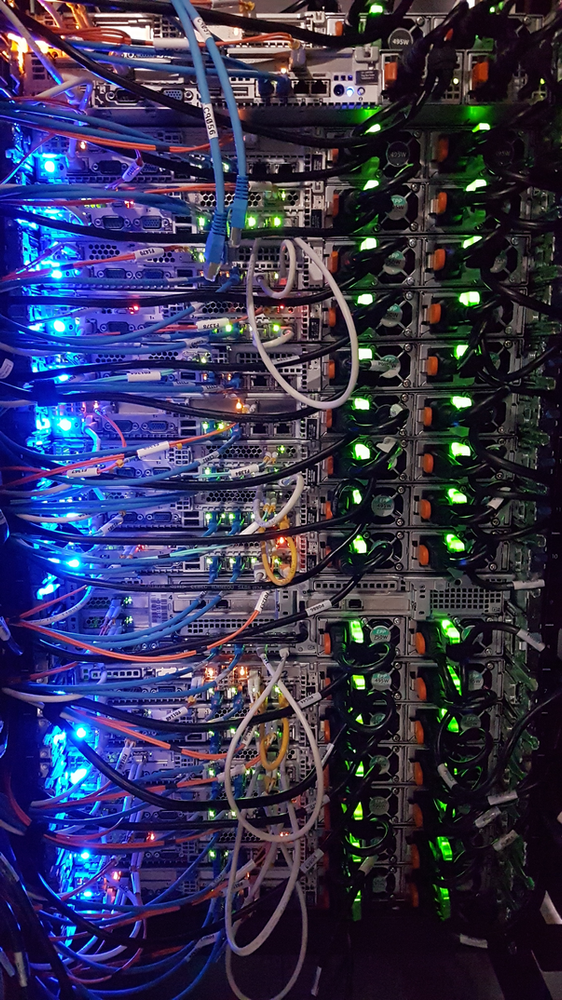
My younger brother and I built our first servers as pre-teens. Using bits we scavenged from second-hand PCs and shareware software that was just as likely to turn your new creation into a house brick as it was to function correctly. We got that the ability to access data, images, music, & games on the internet required power, cooling, hard drives that could ( & would ) fail as well as file management practices diligent enough that your client system could find what you were looking for.
We would rent DVDs for cheap from blockbuster, or from the 50p shelf in charity shops, rip them to AVI, save them on a hard drive and stream them from the family PC to whatever laptop or console we could get a web browser working on. We quickly ran out of storage space for two musically inclined boys worth of CDs so we would rip anything we bought to a server and then re-sell it. we used the files to update our second-hand Zune & Creative Zen micro respectively. It felt a lot less morally dubious than downloading & it was a hell of a lot more convenient.
When LoveFilm, became Netflix, & Netflix, or at least its operating model, became everything, we were probably two of the least surprised teens outside of the silicon valley bubble. Of course, streaming was going to catch on, it’s just better. In our world, People like lots of options & the convenience to engage with the content they are interested in wherever they please. That is what the internet had taught us, inevitably people, if given the right tools, will just build the thing that they want to interact with the world in the way that they want.
We knew that beyond temperamental tech & buggy net code were people. Forums, Trade shows & Tech Repair shops full of interesting people. People who would help you out with driver CDs for obscure brands of LAN card, ask you to test the newest Doom clone they were making for fun, or ask you to contribute character dialogue to their pixel art narrative flash adventure.
These people too, were, archivists, & builders, but also artists, players, writers and designers.
The internet was a connected group of people using the same tools to experience the world in new and interesting ways & it was beautiful (and occasionally terrifying)
None of them were ‘users’ in the modern sense. They all engaged openly and actively in the things they were part of. Semi-open tools that people turned into communities, businesses and entire industries.
Remember Myspace? Probably not. But know this, it was a social media site that encouraged you to tinker with the HTML of your own page. pop it open & see how it worked. Could you imagine Facebook being anything even slightly as open?
I cannot stress enough how that approach to technology, that approach to the people using technology affected everything about me. It is part of the way I think, the way I create, & the relationships I have with the world around me. It’s the driving philosophy behind my writing & media. The reason I took the chance to come & build Overhear.
When I came to Overhear, I brought this view of the world with me. I see the App, the listeners, & the relationships between them as one interconnected entity. A network comprised of sound, space, motion, personality & memory.
It’s my job as Creative Development lead to tinker with that network, be it through community projects that make the most of the technology we have built or technological features that our listeners will utilise to experience space in a new way.
It’s led us to workshops recontextualising the legacies of our public art, the statues, and the subjects of those statues infamous and famous; allowing Overhear listeners to hear the contributions of other voices not present on the plaques and honorifics.
It has taken me to the stroke ward at Sandwell general hospital, working with my fellow wordsmith practitioner Kibriya to capture the experience of stroke recovery and guiding those regaining their grasp on language use to use what they have to create beautiful art with words.
It has led me to dive deep into the structure of the app with fellow technical explorers Tom & Matt to build the most elegant tools we can to fulfil our Just Cause of Moving people physically and emotionally with sound.
It created the opportunity to work with Tom and Kibriya in the first place to bring this wild ideation of an app that works to recontextualise the world through sound to life. Develop a narrative that listeners & investors would understand. Laying out the reasons that we are challenging so much of the established idea of what an App could & should be. (Part of it is that we like making a bit of a ruckus)
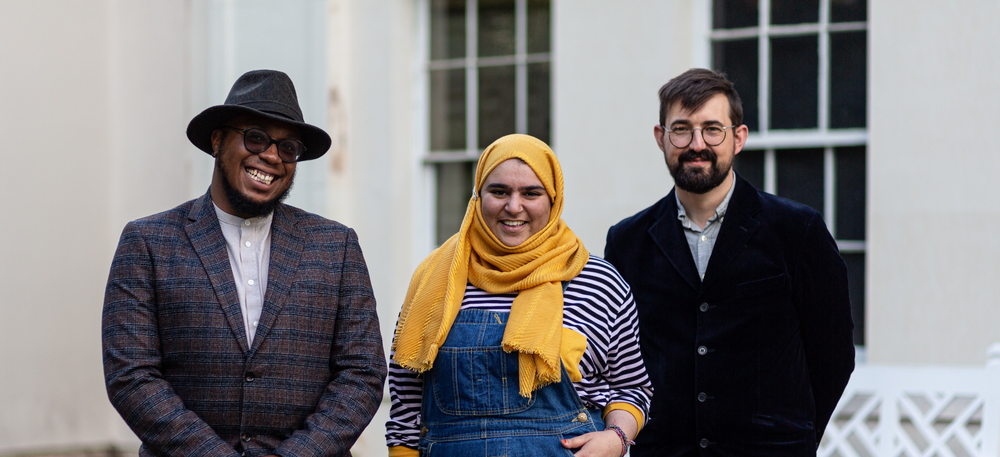
It was this opportunity that created the role of the Listener in the app. Overhear has Listeners, it has poets, it has Explorers, Storytellers & Wanderers.
But it has never really had Users. We didn’t build it to be a passive experience in exchange for lucrative nuggets of time, attention or data.
We built it, are building it, to be a new and interesting way to recontextualise the world around us with the use of technology; true technologically augmented reality.
The dream of the old internet.
It’s all connected you see; it always has been. It is only the modern age of Monopoly and technical ringfencing that has disconnected the internet from the real, making the technical a wall between us and reality rather than a clarifying lens.
I did not come to technology as a User I came as a Player, a Creator, a Coder, a Tinkerer & Builder.
the User is not supposed to be any of those things.
In the words of one of my thought pantheon, the American Anthropologist David Graeber.
“The ultimate, hidden truth of the world is that it is something that we make, and could just as easily make differently.”
The Eddies and Whirlpools of Poetry
I’ve been reading Iain McGilchrist’s book The Matter With Things and it has introduced me to the concept of Turbulent Flow and specifically something that the German Philosopher Joseph Schelling said… ….gosh, with an opening sentence like that I’ve set the expectations quite high… let see if I can deliver.
“Perhaps there is only one point of inhibition from which the whole of nature develops itself” says Schelling, and this has something to do with turbulence and flow. Check out this great video from Veritasium on Turbulent vs Laminar Flow.
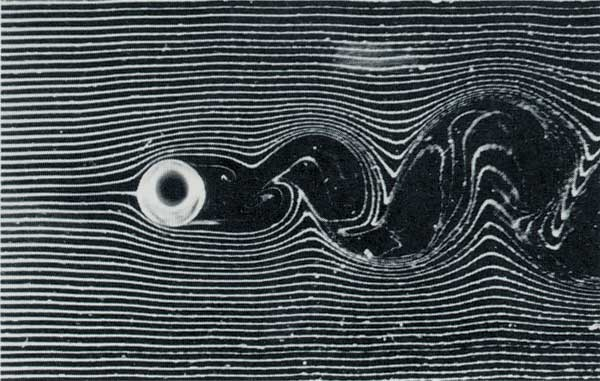 Consider the idea that your existence in time and space is like that of a whirlpool in the cosmos. (I don’t ask for much…) You emerge, maintain stability, and then you reach a point of instability that merges you back into the great stream of all things. Birth, Life, and Death are all one fluid motion.
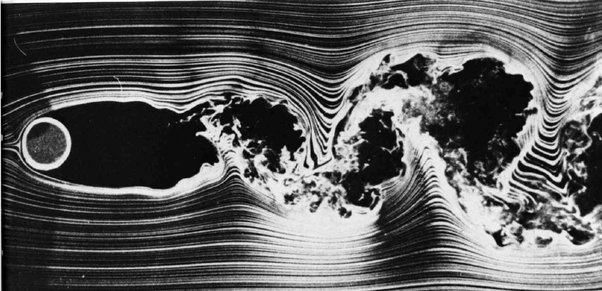
In the picture, you can see an image from above of a stream with an object that produces a resistance, or as Schelling calls it, a point of inhibition. It is this that disrupts the flow and forms the intractable patterns we call turbulence. Turbulence is actually something science is yet to be able to model due to its vast complexities. Schelling is suggesting that perhaps all of what we know and perceive, the universe, love, custard creams, music, laughter, Celine Dion, comes from one point of inhibition in the cosmic stream of things. An idea I love.
It’s a delicate balance though because as Iain McGilchrist also points out, “friction…the very constraint on movement, is also what makes movement possible at all.” When we move through space, we often float on in a laminar stream, but the real creativity comes from those moments of resistance where the laminar parts into a turbulent wake of beautiful weaving eddies and whirlpools. We have to be careful though because if we are too heavy handed we can dam up the stream.
Perhaps you can see where this is going… I feel this is exactly how we can relate to the poetry and audio pinned to location in the Overhear app. It is why we want to invite you to go and stand in a space, feel the stream of words wash over you, and notice what intractable creative thoughts and ideas generate. In this analogy you become the point of resistance from which other creative eddies and pools spring up, and, for a moment, stabilise into something profound and meaningful before it spills back out, integrating into the world.
On Complexity
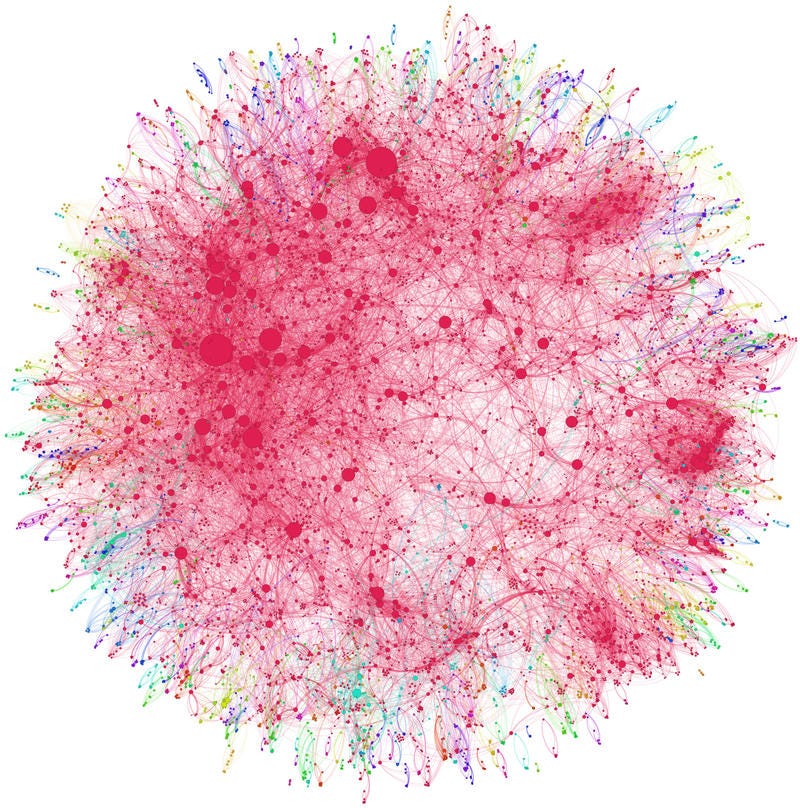 We love complexity at Overhear. That might sound terrifying to you and sure it can be synonymous with chaos and losing control…but the most stable system on the planet, that of Organisms and nature itself, is complex.
However… it’s not complicated. There is a difference between the complex and the complicated: a machine is complicated but an Organism is complex. Flatpack instructions can be complicated but poetry can be complex. First dates are complicated but relationships are complex. One is flat and linear the other is rich and alive.
Here is Jordan Hall giving a quick overview of David Snowden’s Cynefin (pronounced “ku-nev-in,” a Welsh word meaning “place” or “habitat.”) framework that I find useful.
https://www.youtube.com/watch?v=su91uPR_jmM&t=1s
And this is what I love about Overhear. When we put poems in locations we can’t predict what will arise for our listeners. The complexities of the poetry, the place and you as the listener converging together provide the turbulence for all sorts of insights to arrive, each one rich and meaningful, deep and profound, if we only just stop, be present and listen. At Overhear, we believe that embracing complexity is akin to embracing life itself. Just as a symphony is composed of a myriad of notes, harmonies, and instruments, life is a blend of experiences, emotions, and relationships. While it’s easy to get overwhelmed by the intricate details, it’s essential to remember that it’s these very intricacies that make the melody memorable. The beauty lies in the unpredictability, the unexpected twists and turns, the crescendos and the pauses.
In our fast-paced world, we often seek simplicity for convenience. But in doing so, we might miss out on the depth and richness that complexity brings. Overhear’s mission is to reintroduce you to this depth, to help you find the music in the chaos. With our Wanders subscription, we invite you to dive deep, to explore, and to find the rhythm in the cacophony. It’s not just about understanding poetry or a place, but about understanding yourself and the intricate web of life that surrounds you. Embrace the complexity, and you’ll find a world teeming with wonder.
Wisdom from the Ward
After a day of co-facilitating workshops with patients on Sandwell Hospital’s Stroke Recovery Ward, Kibriya reflects on the way we think about hospitals and what Overhear aims to accomplish in these spaces.
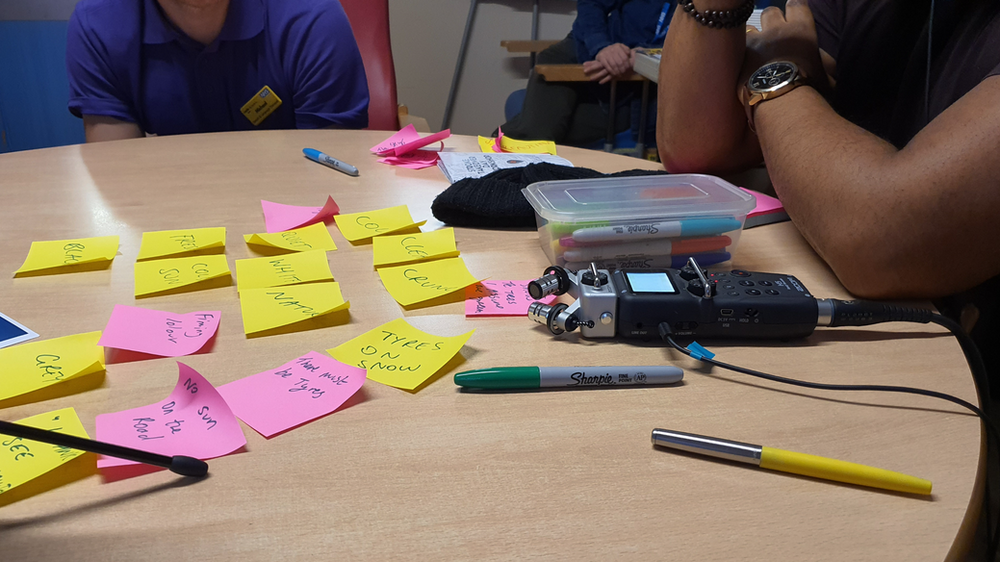
When I woke this morning, I was anxious about the schedule; Adrian and I were set to run a workshop at Sandwell Hospital as part of Overhear’s collaboration with the Midland Met – yet to be built. I was stressed about getting our resources together on time, worried about how the participants were going to receive what we’d planned and, honestly, mostly, nervous about having to spend a significant amount of time on a ward, and possibly having to confront some less-than-great memories.
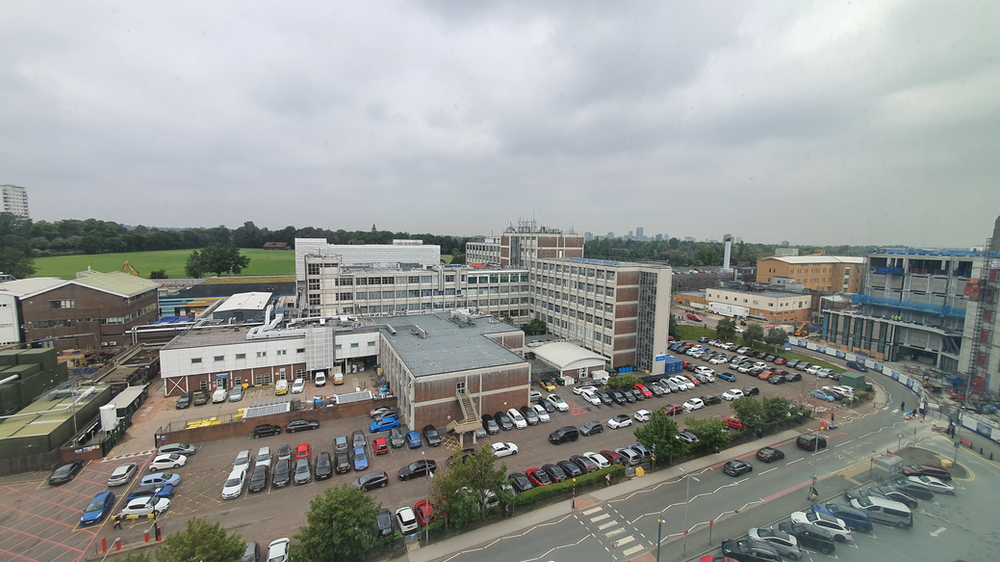
Plenty of us have negative associations with hospitals – and for good reason. We spoke to one patient who was very firm with us that she wanted out immediately and if she never came back it would be too soon. I’ve no doubt that she was voicing the thoughts of a lot of the people who have had to stay on a ward for any amount of time. Another patient talked about how overwhelming it all was when they were first admitted, the shock of becoming dependent on others for basic needs, the fear of asking questions like when is it okay to press the call button? As we talked with these participants, their families and the staff who’d worked with them, however, the overwhelming theme was of determination and celebration. When stroke – or any life-changing illness – occurs, it can change everything: the way you live your life, the way you communicate, your whole sense of self. Every single person we talked to was in the process of building themselves back up from a place they never imagined themselves to 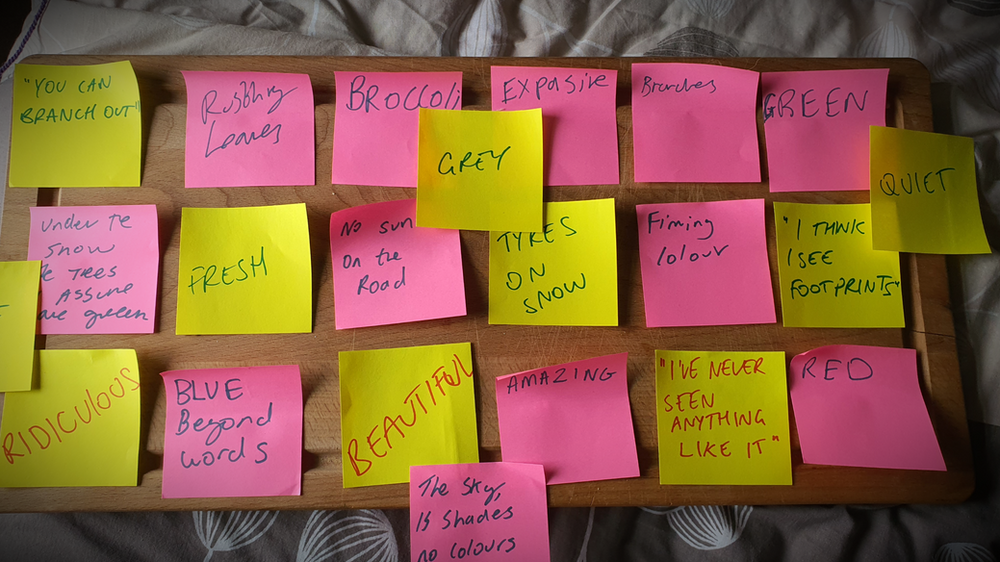 be and yet every single one was taking it in their stride. I’m a man on a mission, said one patient. I’m not into toxic positivity or reducing people who go through terrible, difficult things to ‘inspiration’ for those who haven’t. Everyone in that room knew that progress was not linear, that recovery is not ticking off a series of boxes on a checklist, that there were hours and days and weeks where they might feel devastated, frustrated, furious. The things that they held onto were often small victories, small joys: going from a 1 to a 2 on the IDDSI Diet Levels chart, the aim of playing board games with their grandchildren, reaching for a word and finding it. It made me appreciate that while hospitals hold difficult memories for many of us, they’re also the places where the wonderful minutiae of human life are given their due. That’s where you celebrate being able to eat a Greggs Sausage Roll, where you say out loud to your mother I’m so proud of everything you’ve done, where every word can be a miracle. If Overhear can play any part in recognising that, and in helping other people who pass through the space to find and focus on that joy, then I’ll feel very justified in celebrating a victory.
Poetry through Motion
Apparently, if you restrict the movement of your hands you’ll find it harder to find the right words because gesticulation aids cognition. (Mr. Blobby being an exception here of course)

Aristotle famously walked while teaching in his peripatetic school to aid talking and thinking, I’d like to think he also gesticulated wildly as such a profound thinker…
I mention this because I’m continuing my reading of Iain McGilchrist’s The Matter With Things and in the chapter on Movement and Flow he says:
“our knowledge of anything is embedded in movement since, as (Johann Gottlieb) Fichte too had seen, consciousness is not a fact, or a thing – but an act. It is not just that it is a flowing movement, as (William) James saw: it is that movement unites me with the world. Motion is intrinsic to the betweenness, and the directedness, of consciousness itself so Consciousness is always consciousness of something, reaching out and going to meet something beyond the self, not. self-enclosed Cartesian theatrical display, but a reverberative process, already aimed towards the real, living world – out of which it also comes.”
Whooof, that one probably takes a couple of read-throughs. Still, it is rich with ideas about how movement not only aids our cognition, as Aristotle found with his peripatetic school, but that consciousness is movement and movement is consciousness. “Movement unites me with the world.” “Reaching out and going to meet something beyond the self…”
Interestingly, understanding is often related to movement. “Do you see where I’m coming from” “Did you catch my drift.” “I think I missed the point, maybe you’re going too fast for me” “Can you run that past me again”
Here’s another fascinating part that McGilchrist picks up from Henri Bergson:
“We say that movement is composed of points, but it comprises, in addition, the obscure and mysterious passage from one position to the next. As if the obscurity was not due entirely to the fact that we have supposed immobility to be clearer than mobility and rest anterior to movement!”
McGilchrist is using this to highlight our desire to pin everything down and immobilise it so that it can be analysed when so many things in the world need to be experienced as an interconnected whole.
Bergson also says:
“How could the moving object be at a point of its trajectory passage? It passes through, or in other terms, it could be there. It would be there if it stopped; but if it should stop there, it would no longer be the same movement we are dealing with…”
Get that for a bit of paradox! You can’t experience movement as a series of points but only as its fluid motion. I believe this is what is meant by the phrase “Motion is intrinsic to betweenness.”
There is something about being at an interface with the world that requires a dynamic, fluid and moving disposition to be conscious of it. That’s where Poetry comes in…
Now, forgive me for forever taking these fascinating insights and making it all about us at Overhear but we are really resonating with this! Overhear’s aim is to Move People. We want listeners to find our recordings and experience them as a fluid interconnected extension of that space. To continue that movement physically and mentally, letting the words guide listeners in that location and take them to places they never knew could open up before them.
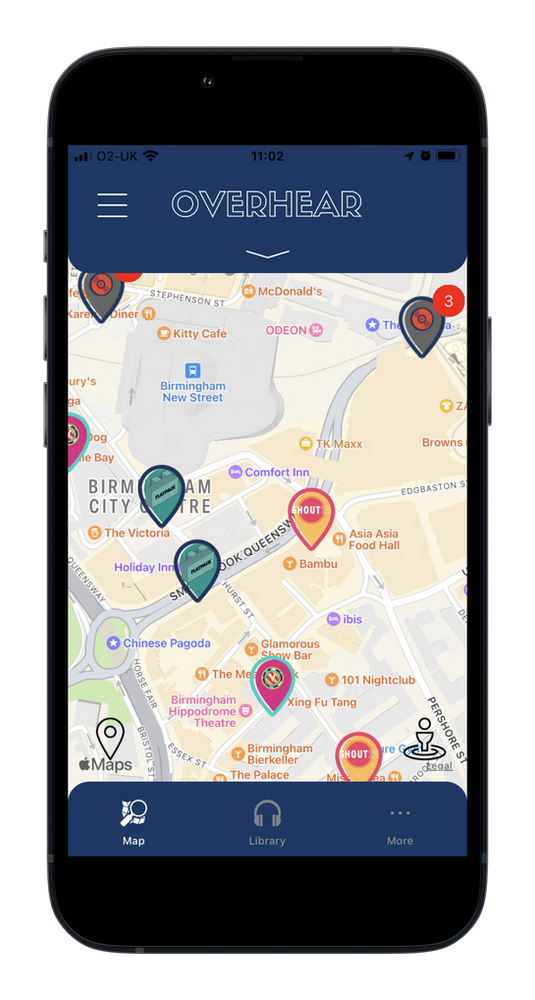
Our pins may be static representations of location on a digital map of zeros and ones, but we hope they signify portals to fluid places of movement, interconnectedness and vitality!
Check out our previous posts inspired by The Matter With Things, this one is on Turbulent Flow and this one by Kibriya on running workshops with patients recovering from strokes.
Also we’ve been featured on Outdoor Arts UK’s blog check that out here.